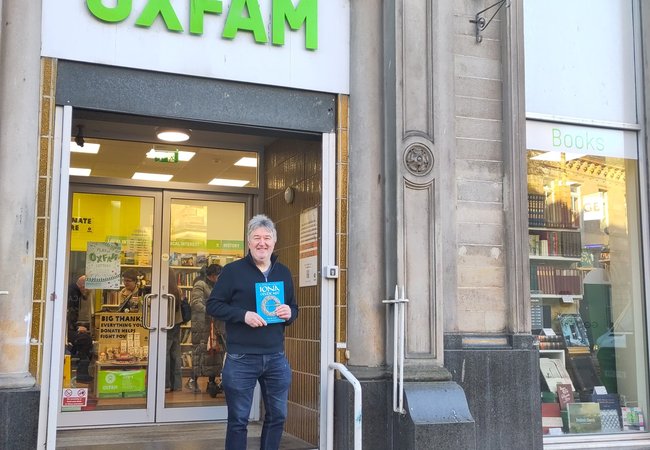
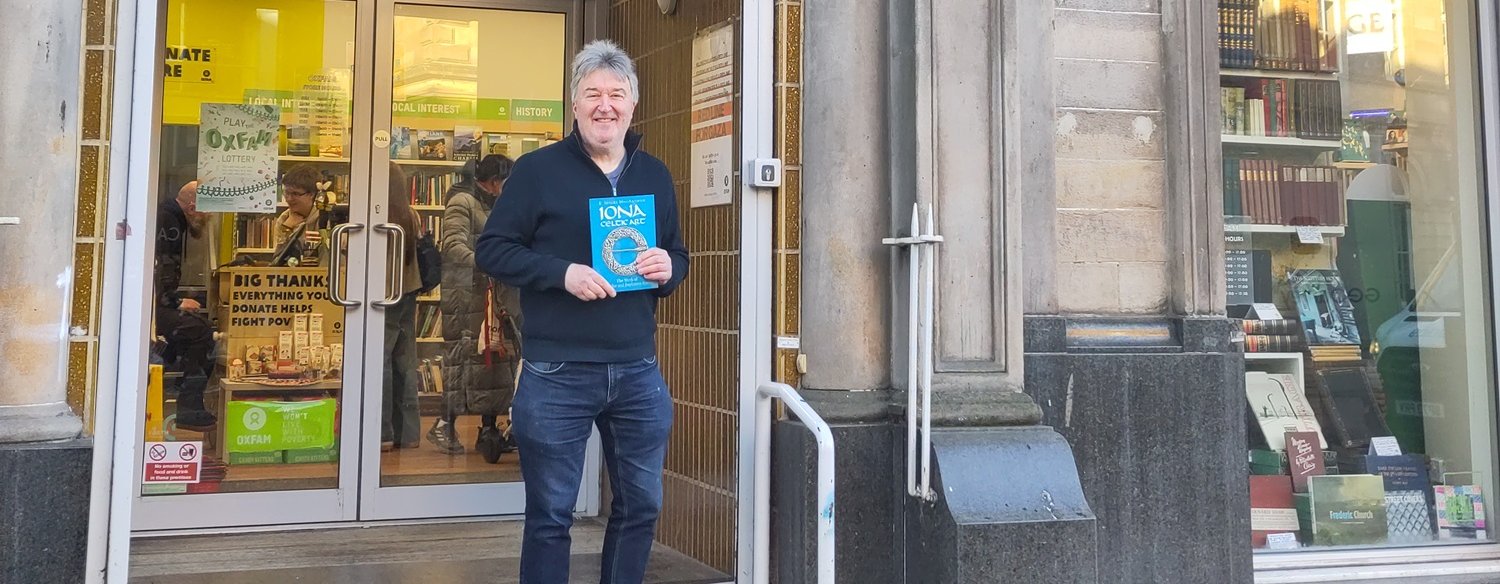
Oxfam’s high network of 40 Scottish street shops report non-fiction sales up 16% this financial year, with overall second-hand book sales up 4.4% since 2023, and the year isn’t over yet.
Amid the numbers, one story stands out.
For years, Paul Dixon, 66 from Dunblane, had been searching for a single book.
Not a rare medieval manuscript or a leather-bound Latin volume (though he’s come across plenty of those), but a slim paperback called Iona Celtic Art. The much-loved reference book is a must-have for anyone interested in Arts & Crafts design - a movement celebrating handcrafted, decorative work and the Glasgow School of Art.
“I first heard about the book around five years ago,” Paul says. “I’m a big fan of Arts & Crafts and the Glasgow School of Art, and I own a couple of pieces by Alexander Ritchie, the renowned Scottish silversmith and metalworker. Once I knew the book existed, I just had to find a copy.”
He looked everywhere. Visited bookshops across the UK. Searched specialist sellers. Even contacted shops on Iona – the small, remote island off the west coast of Scotland – to ask them to hunt through their bookshelves.
“It became slightly ridiculous,” Paul laughs. “I could turn up extremely rare books from all over the place, but this one little paperback, published within my lifetime, completely eluded me.”
A familiar joke in a familiar shop
One place the missing book became a regular talking point was Oxfam’s Stirling bookshop, where Paul would often stop by on his travels.
“It turned into a running joke,” he says. “Every time I came in, we’d talk about it. I think we all started to wonder if it even existed.”
So when Shop Manager Neil finally spotted a copy amongst the piles of books donated in support of Oxfam’s work tackling poverty, he knew exactly what to do.
“We’d spoken about that book so many times,” Neil says. “When it came in, we put a sign in the window asking Paul to pop in to see if it was the one he’d been searching for.”
And then… nothing.
“I kept expecting him to walk through the door,” Neil adds. “At one point I even saw him outside the shop tying his shoelaces. I was serving customers and couldn’t get away, and by the time I looked again, he’d gone.”
Inside the shop, the comparisons began.
“We started joking that it felt a bit like the old Yellow Pages J.R. Hartley advert,” Neil says. “Someone going from shop to shop for years, determined to track down one particular book and then finally, at long last, finding it.”
The classic Yellow Pages advert, which first aired in the UK in 1983, featured an increasingly frustrated gentleman called J.R. Hartley who searches book shop after book shop for a copy of his own book, Fly Fishing, which is out of print. The ad became hugely popular.
At last, the book appears
In truth, Paul hadn’t even seen the sign in the shop’s window.
“My first reaction when I finally heard was complete disbelief,” Paul says. “I’d actually paused the search before Christmas because I was so busy, I never spotted the sign in the window. I couldn’t quite believe it had turned up after all that time.”
When he finally took the book home, the wait felt worthwhile.
“It’s going to be a brilliant reference,” Paul says. “It has early photographs of jewellery you don’t see very often, as well as examples of Ritchie’s metalwork and wooden pieces that were never marked. It fills in all sorts of gaps.”
And while it doesn’t include an image of the pair of vases Paul owns, “which I’m still fairly convinced are Ritchie,” he adds with a smile, the book has already earned a special place on his shelf.
More than just a bookshop
For Shop Manager Neil, the moment captures what charity bookshops do best.
“It’s not just about selling books,” he says. “It’s about conversations, shared interests, and sometimes helping someone finish a search they thought might never end.”
Unlike J.R. Hartley, Paul didn’t need the Yellow Pages. He just needed a patient Oxfam bookshop team who always kept the faith.